

If your tailbone starts aching within an hour or two of sitting down, you already know the pattern. You shift left, shift right, lean forward a little, and still cannot find a position that feels neutral. By mid-afternoon the discomfort has spread into your lower back. By the end of the workday you stand up slowly and walk a little stiff for the first few minutes. I have been there. It took me longer than it should have to realize the fix had nothing to do with getting a better chair.
Tailbone pain from sitting, sometimes called coccydynia when it gets clinical, usually comes from two things: direct pressure on the coccyx from a seat that does not distribute weight properly, and a forward pelvic tilt that loads the lower spine unevenly over hours. Most office chairs, including mid-range ones that cost several hundred dollars, have seats that are flat or slightly concave. That design puts all your sit-bone and tailbone weight on a narrow band of foam that compresses within the first few minutes. The Everlasting Comfort Memory Foam Seat Cushion addresses both of those issues, and it is the first thing I recommend before anyone spends money on a new chair. The rest of this guide covers the full fix: cushion, posture, movement breaks, and a few chair adjustments that most people never bother to make.
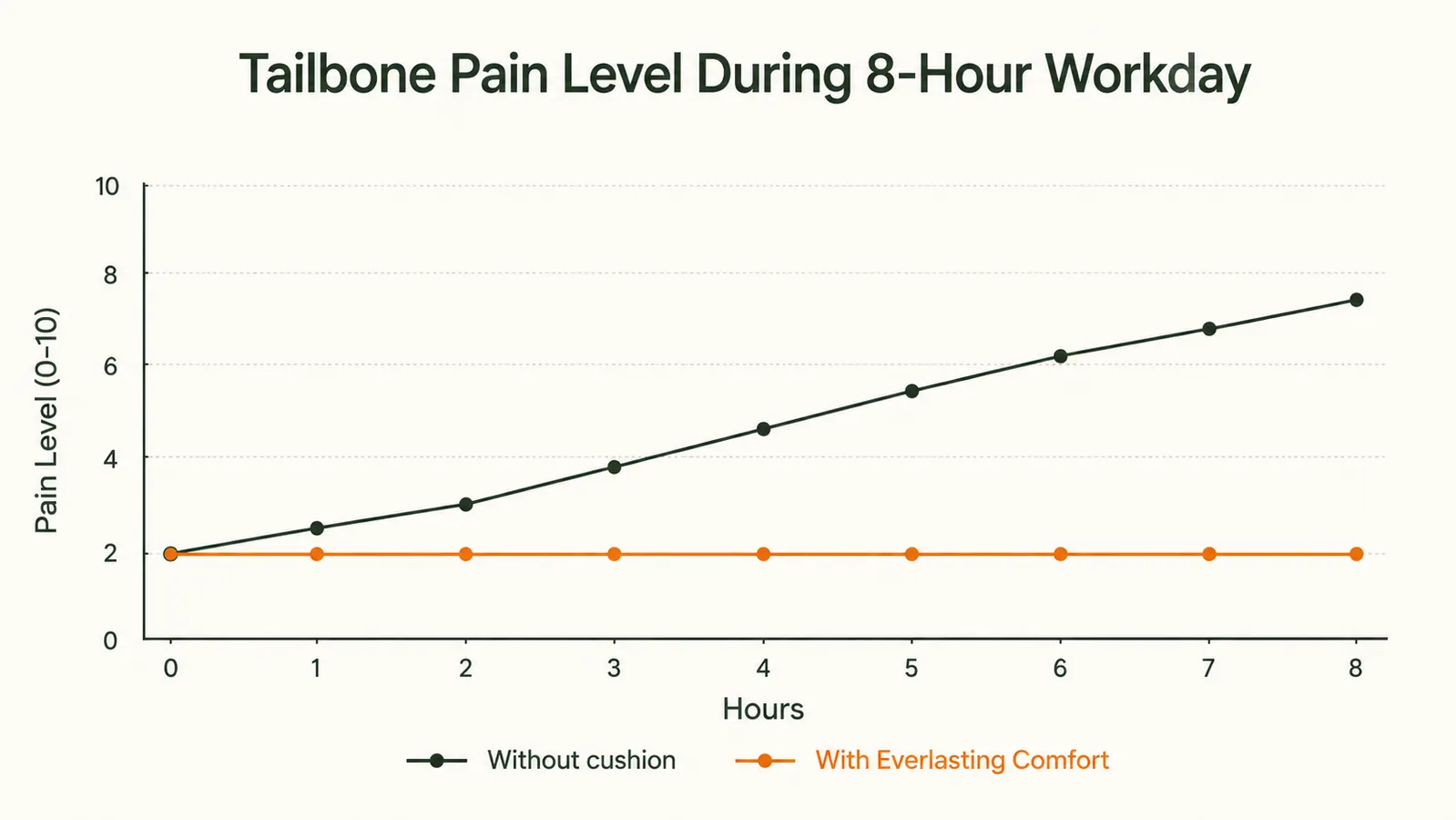
Your tailbone hurts because your seat was not designed for eight-hour shifts. This cushion was.
The Everlasting Comfort seat cushion uses a U-shaped cutout to keep your coccyx completely suspended, so the bone that hurts never actually touches the seat. It has 123,000+ Amazon reviews and a 4.4-star rating. Check today's price and see if it ships to you before you read another word.
Amazon Check Today's Price on Amazon →Step 1: Understand Where the Pain Is Actually Coming From
Before you fix anything, get specific about what hurts. Sit down right now and notice: is the pain at the very base of your spine, right at the tip of the coccyx? Or is it more of a deep ache in the center of your seat area, which would be the sit bones (the ischial tuberosities)? Or is it higher, in the lumbar? Each of those points to a slightly different fix.
Coccyx pain is the sharp, sometimes bruised-feeling ache at the very bottom of your spine. It gets worse when you go from sitting to standing. Sit-bone pain is more of a dull pressure soreness that spreads symmetrically. Lumbar pain rides higher and often tightens after an hour. This guide focuses on coccyx and sit-bone pain, because those are the two the right seat cushion can fix directly. If your main complaint is lumbar, a lumbar pillow is the better starting point and I cover that in the comparison article linked below.
Spend two minutes pressing along the back of your seat and feeling for where you contact the chair surface. If you can feel the seat structure through the foam, that seat has bottomed out for your body weight. That is a direct cause of coccyx pressure, and no amount of posture work fully compensates for it.

Step 2: Add a Memory Foam Seat Cushion with a Coccyx Cutout
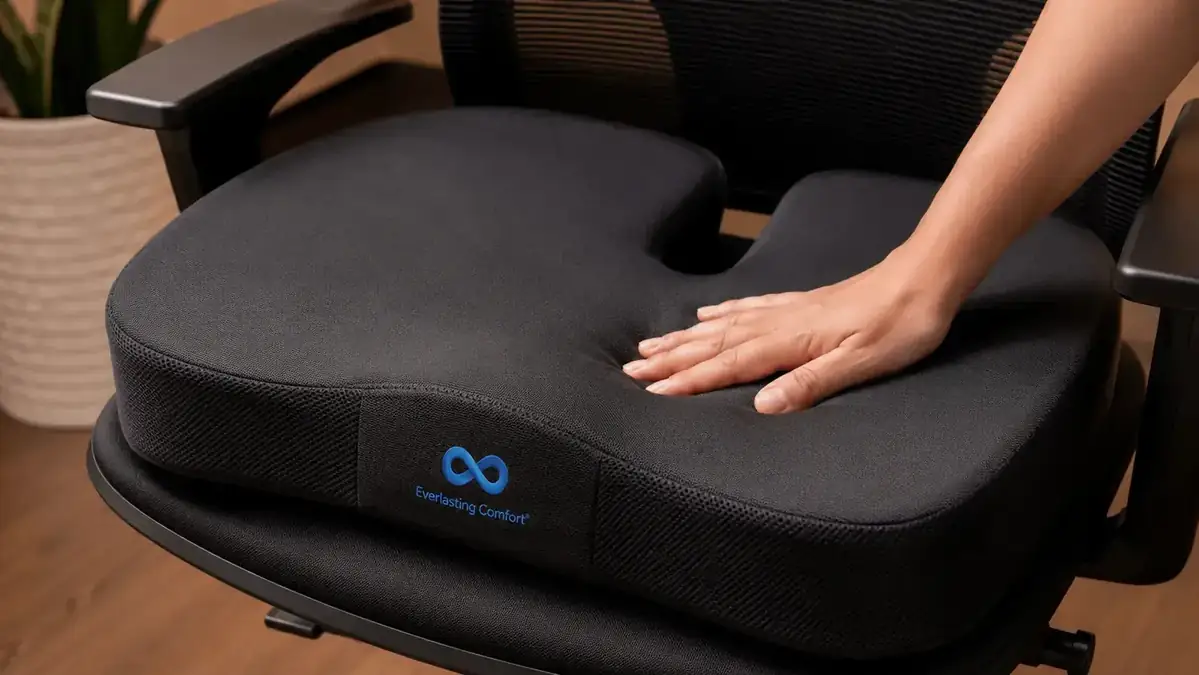
This is the highest-leverage fix and the one that produces results the same day you try it. A standard seat puts foam under every inch of your seat area including directly under the tailbone. A coccyx cushion has a U-shaped or wedge-shaped cutout at the rear so the very tip of your spine sits in open air. The tailbone never touches the surface. The weight your body would have put through the coccyx gets redistributed to the broader sit-bone area and the upper thighs, which are built for load-bearing.
The Everlasting Comfort cushion is the one I point people to because it uses high-density pure memory foam, not the cheap rebounded stuff that compresses to nothing in a few weeks. It is doctor-recommended and the U-cutout is deep enough to actually work, not just cosmetic. With 123,000 Amazon reviews, the real-world data set is huge: reviewers with tailbone injuries, post-surgery recovery, long-haul truck drivers, people doing eight-hour desk shifts. The pattern in the positive reviews is consistent: tailbone pressure gone or dramatically reduced within the first couple of uses. The honest criticism in the lower reviews is that taller or heavier users sometimes feel the foam is softer than expected over time, which is worth knowing.
Put the cushion on your chair with the flat edge at the front and the U cutout at the back. Sit down and make sure your coccyx is hovering in that gap. If you have to scoot backward to find the cutout, the cushion may be positioned too far forward. Give it a few minutes and then pay attention to whether the pressure at your tailbone is gone. For most people, the relief is noticeable immediately.
Step 3: Adjust Your Chair Height So Your Hips Are Level or Slightly Higher Than Your Knees
Even with a good cushion, a chair that is set at the wrong height can reload your tailbone with pressure. The goal is a neutral pelvis: sitting tall with your hip joints at roughly the same height as your knees, or slightly above. When the chair is too low your pelvis tilts backward (posterior tilt) and your coccyx digs into whatever surface is under you. When the chair is too high your feet dangle, your thighs slope downward, and weight shifts toward the back edge of the seat, again onto the tailbone area.
Sit down on your cushion and put both feet flat on the floor. Your thighs should be roughly parallel to the floor or angled very slightly downward at the knee. If you have to lift your feet or your thighs are pressing up against the seat edge, raise the chair. If your feet dangle, lower the chair or add a footrest. This one adjustment alone, when the chair has been too low for years, can make a noticeable difference in tailbone pressure even before the cushion arrives.
The tailbone should never actually touch your seat surface. If you can feel it making contact, your chair is failing you and no amount of posture work will fix the source of the problem.

Step 4: Correct Your Seated Posture So Your Lower Spine Is Supported
Posture is the piece people skip because it requires ongoing attention, not a one-time purchase. But it matters. When you sit with a slumped lower back, the pelvis rotates posteriorly and every pound of upper-body weight funnels through the coccyx instead of spreading across the sit bones. The fix is to sit with a gentle inward curve in your lower back rather than letting it round outward.
A quick way to find the right position: sit on the edge of your seat and let yourself slump completely. Then slowly pull yourself all the way upright and exaggerate the inward curve of your lower back. Then release about ten percent of that exaggeration. That is your neutral spine. It should feel like you are sitting tall without straining. If your chair has a lumbar support knob, adjust it until it supports that slight inward curve without pushing you forward. The memory foam seat cushion helps here too because it has a slight forward wedge angle that encourages the pelvis to tilt forward naturally, making neutral spine easier to maintain.
You will not hold perfect posture for eight hours straight. Nobody does. But developing a habit of resetting your posture every thirty minutes, even just for thirty seconds, adds up. Set a phone timer if you need to. Over a few weeks the neutral position becomes more automatic because the muscles that support it get stronger.
Step 5: Build a Movement Break Routine to Unload the Spine
No cushion or posture fix eliminates the fact that sustained sitting compresses spinal discs, tightens hip flexors, and reduces blood flow to the soft tissue around the coccyx. You have to break it up. The research suggests that getting up for even two or three minutes every forty-five to sixty minutes is enough to reset the pressure that builds up with prolonged sitting. You do not need a standing desk or a walking pad to do this, though both help.
A practical routine: every forty-five minutes, stand up and do three to five minutes of light movement. Walk to the kitchen for water. Do a few hip circles. Stand and roll your shoulders back. The specific movement matters less than the habit of breaking the sustained compression. If you want a structured anchor for this, I cover a more detailed movement system in the guide to staying active while working from home. The point here is simple: even the best seat cushion cannot compensate for sitting without a break for four or five hours at a stretch.
What Else Helps
A few other things worth mentioning. First, a seat cushion only solves the pressure problem. If you have an existing tailbone injury, such as a fracture or bruised coccyx from a fall or an accident, that is a medical situation and a cushion is a comfort measure, not a treatment. See a doctor. A donut cushion or a U-shaped coccyx cushion like the Everlasting Comfort will reduce aggravation while you heal, but it will not accelerate healing on its own.
Second, if your chair is older than five to seven years and the seat foam has visibly deformed or feels like you are sitting on plywood through the cushion, a seat cushion will help but it is working against a significant deficit. At that point the chair is probably overdue for replacement and the cushion is a short-term bridge.
Third, pay attention to what you sit on outside of work. Car seats, couches, and dining chairs all pile onto the total daily load on your coccyx. Some people notice their tailbone pain is actually worse on days they have a long commute or spend extended time on a firm couch, not just from the desk. Knowing the full picture helps you prioritize where the cushion matters most.
If you want a more detailed breakdown of whether a seat cushion or a lumbar pillow is the right first fix for your specific chair problem, the comparison article covers exactly that. And if you are not sure whether a cushion is the right call or whether your chair has other issues worth addressing first, the 10 signs article runs through the diagnostic checklist.
If your tailbone hurts every day at your desk, the Everlasting Comfort cushion is the fix I recommend first.
It has the U-shaped cutout that keeps your coccyx suspended in open air, high-density memory foam that does not bottom out, and over 123,000 Amazon reviews backing it up. For most people it works on the first day. Check today's price and see what ships to you.
Amazon Check Today's Price on Amazon →