
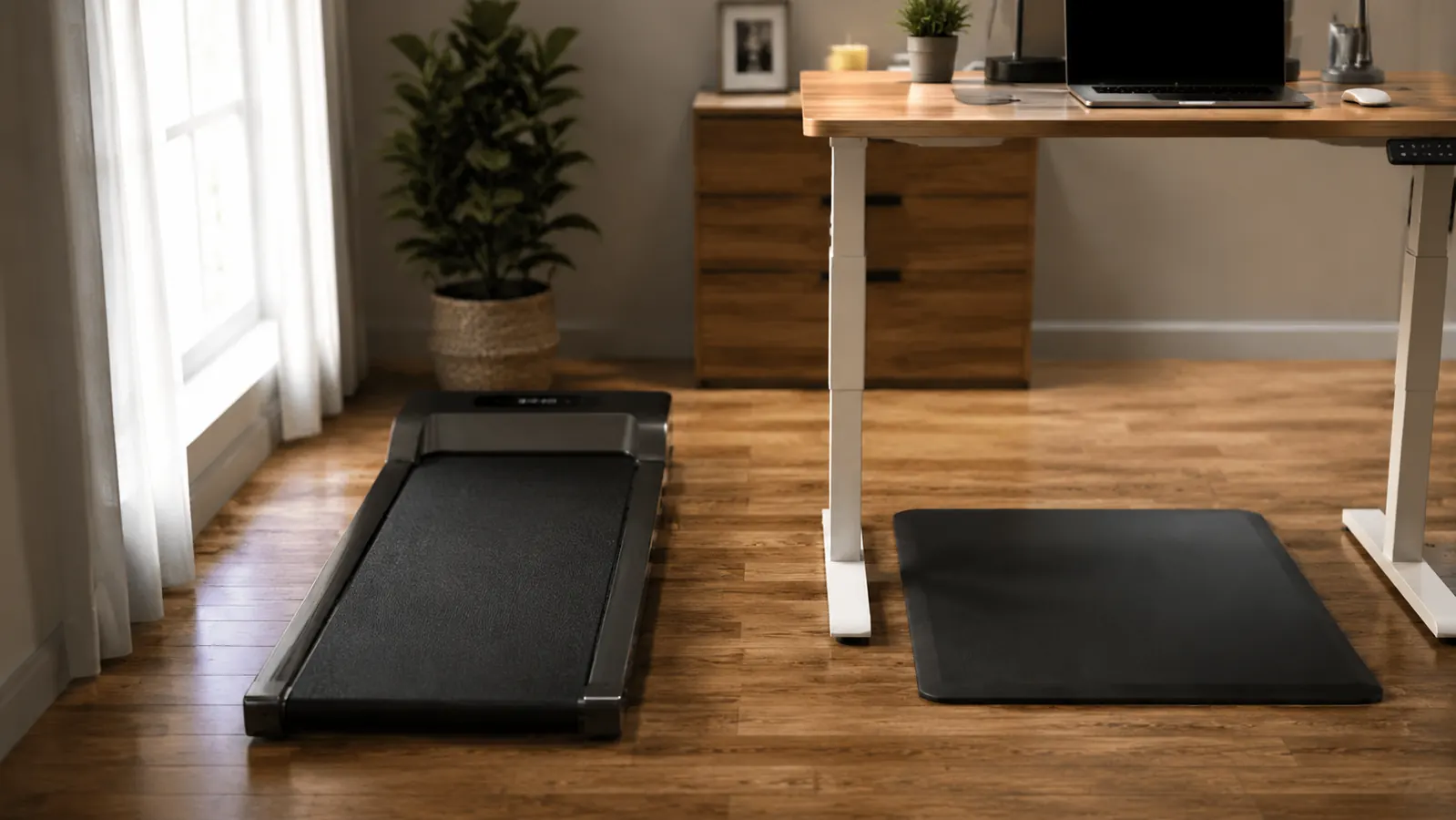
Here is the short answer: if you are already standing at your desk and you just want your feet to feel less wrecked at the end of the day, an anti-fatigue mat will do that job at a moderate price. But if your real problem is that you sit for eight hours straight, feel foggy by 2pm, and your doctor keeps telling you to move more, a walking pad like the TRAILVIBER is in a completely different category. One cushions your feet. The other changes your entire afternoon.
I have used both. I had an anti-fatigue mat for about a year before I made the switch to an under-desk walking pad. The mat helped a little with foot fatigue. The walking pad helped with everything else. That is the honest version of this comparison, and I will walk you through all the details below.
| Walking Pad | Standing Desk Mat | |
|---|---|---|
| Price | Check today's price on Amazon | Mid-range to higher-end |
| Calories burned per hour | Approx. 200 to 350 (at 1.5 to 2.5 mph) | Approx. 20 to 30 (passive standing) |
| Movement type | Active walking at adjustable speed | Static standing with cushioning |
| Incline options | 9 auto-incline levels up to 12% | None |
| Weight capacity | 450 lbs | Typically 250 to 350 lbs |
| Noise level | Low motor hum, suitable for calls with headset | Silent |
| Space footprint | Approx. 60 x 20 inches, slides under desk | Approx. 30 x 18 inches |
| Storage | Stands upright against wall (folds flat) | Flat under desk or in closet |
| Requires power outlet | Yes | No |
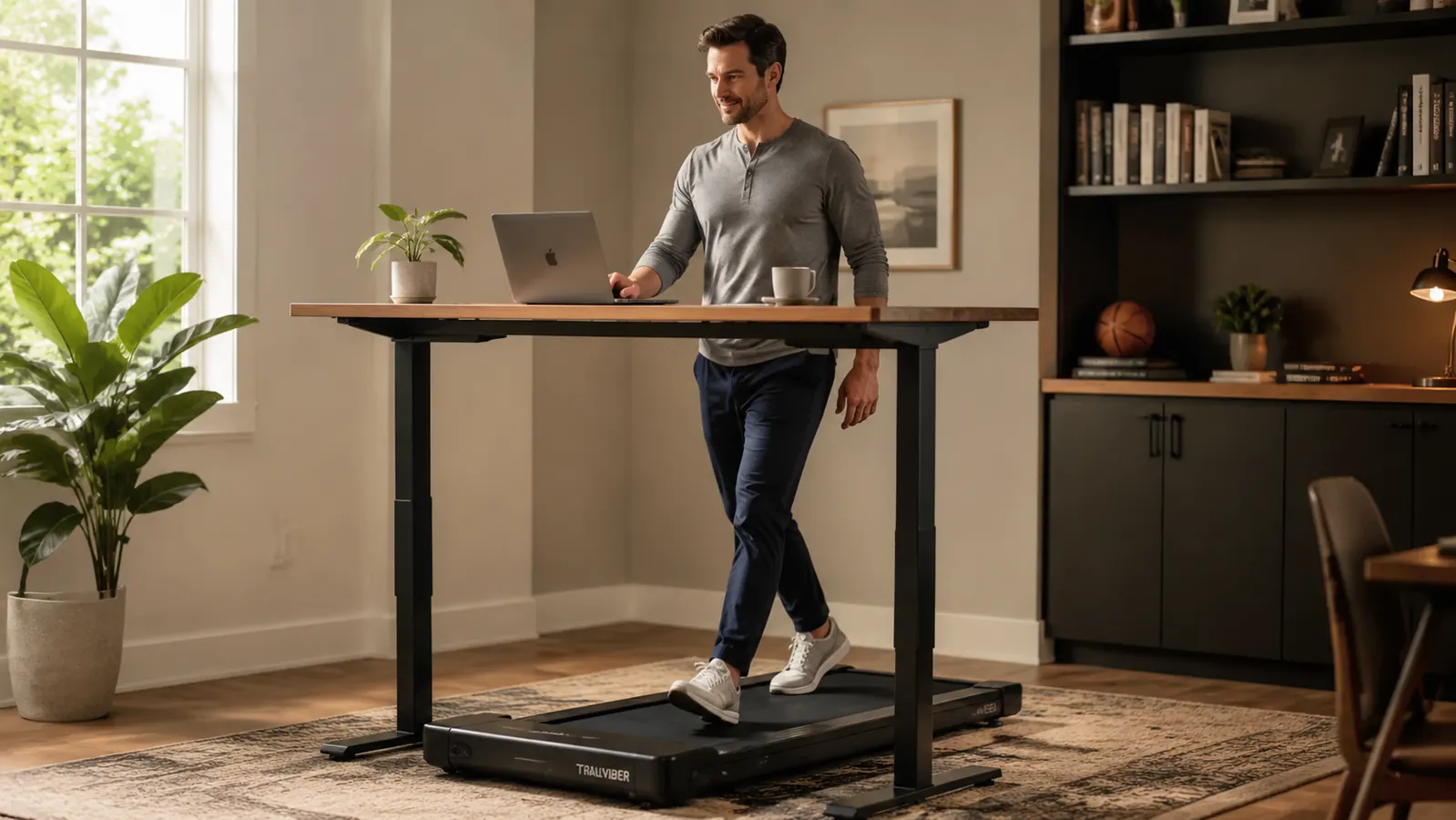
Where the TRAILVIBER Walking Pad Wins
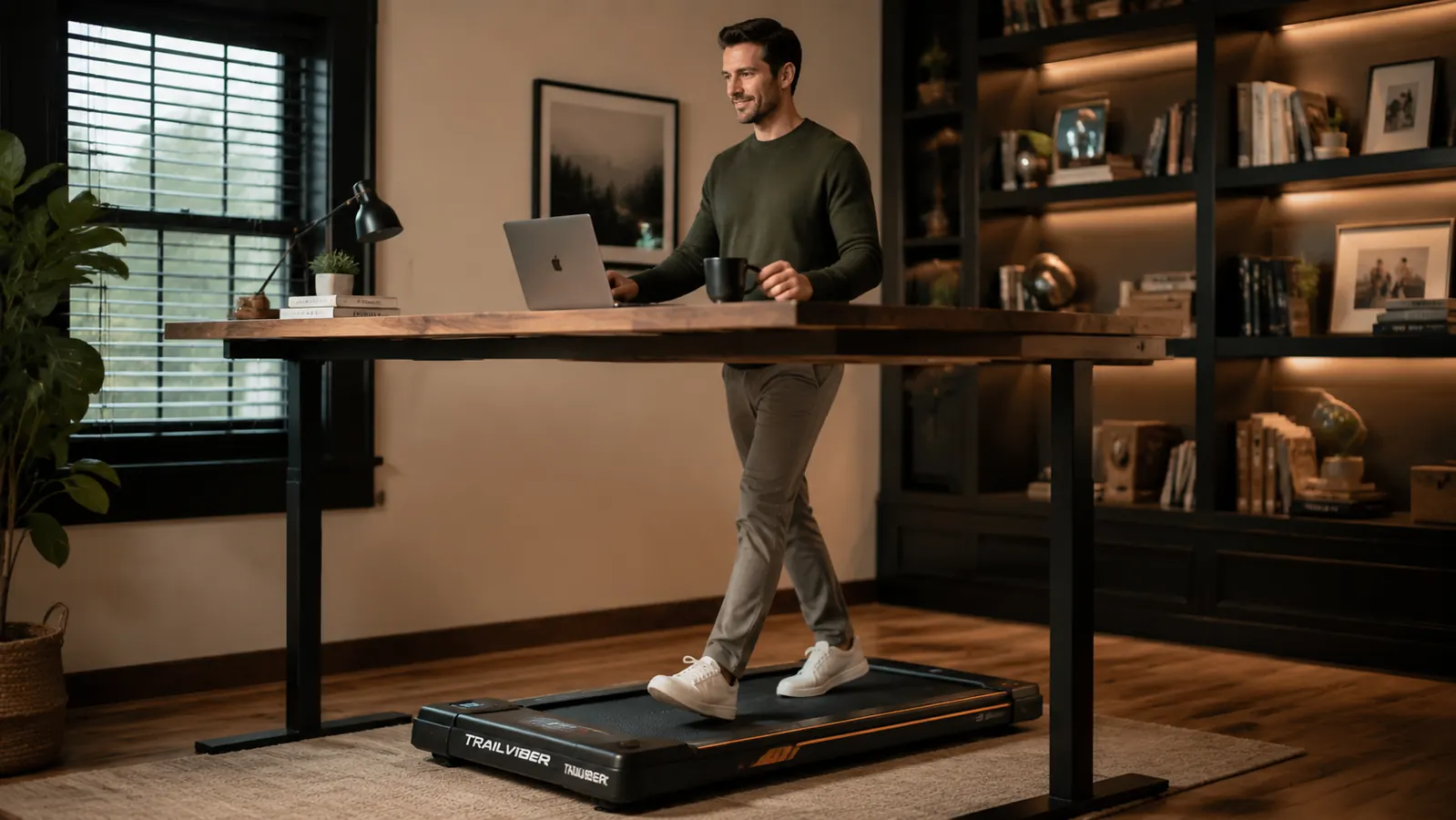
The single biggest advantage of the TRAILVIBER is that it makes movement automatic. You do not have to think about it. You set the speed to 1.5 mph, you open your laptop, and you are walking. Over the course of a four-hour morning, you might cover four or five miles without ever feeling like you exercised. That is the whole point. The research on non-exercise activity thermogenesis, or NEAT, shows that low-intensity movement throughout the day is one of the most effective things you can do for long-term energy, metabolic health, and afternoon brain function. An anti-fatigue mat does not touch any of that. It just makes standing a little more comfortable.
The TRAILVIBER also has a genuinely impressive spec for this category: 9 auto-incline levels up to 12 percent and a 450-lb weight capacity. Most walking pads in this price range max out at 265 lbs and offer no incline at all. The incline matters more than it sounds. Even a 3 or 4 percent incline at 2 mph meaningfully increases your calorie burn and engages your calves and glutes in a way that flat walking does not. If you are a bigger person, that 450-lb capacity also means you are not white-knuckling it every session wondering if the belt is about to give out. The TRAILVIBER currently holds a 4.7-star rating across nearly 2,000 reviews on Amazon, which is strong for a product at this price point in a crowded category.
Typing and using a mouse on a walking pad takes about a week to feel natural. Once you adjust, you can handle email, Slack, reading documents, and most video calls without any problem. The one exception is precision work: detailed photo editing, fine spreadsheet work, or anything that requires a very steady hand. For that, you step off and sit down. Most people find they naturally use the pad for 30 to 90 minutes at a stretch, then sit for focused work, then get back on. That rhythm ends up being a better setup than either sitting all day or standing all day.
I burned more calories between 9am and noon on the walking pad than I did in a 25-minute gym session. That was not something I expected when I bought it.
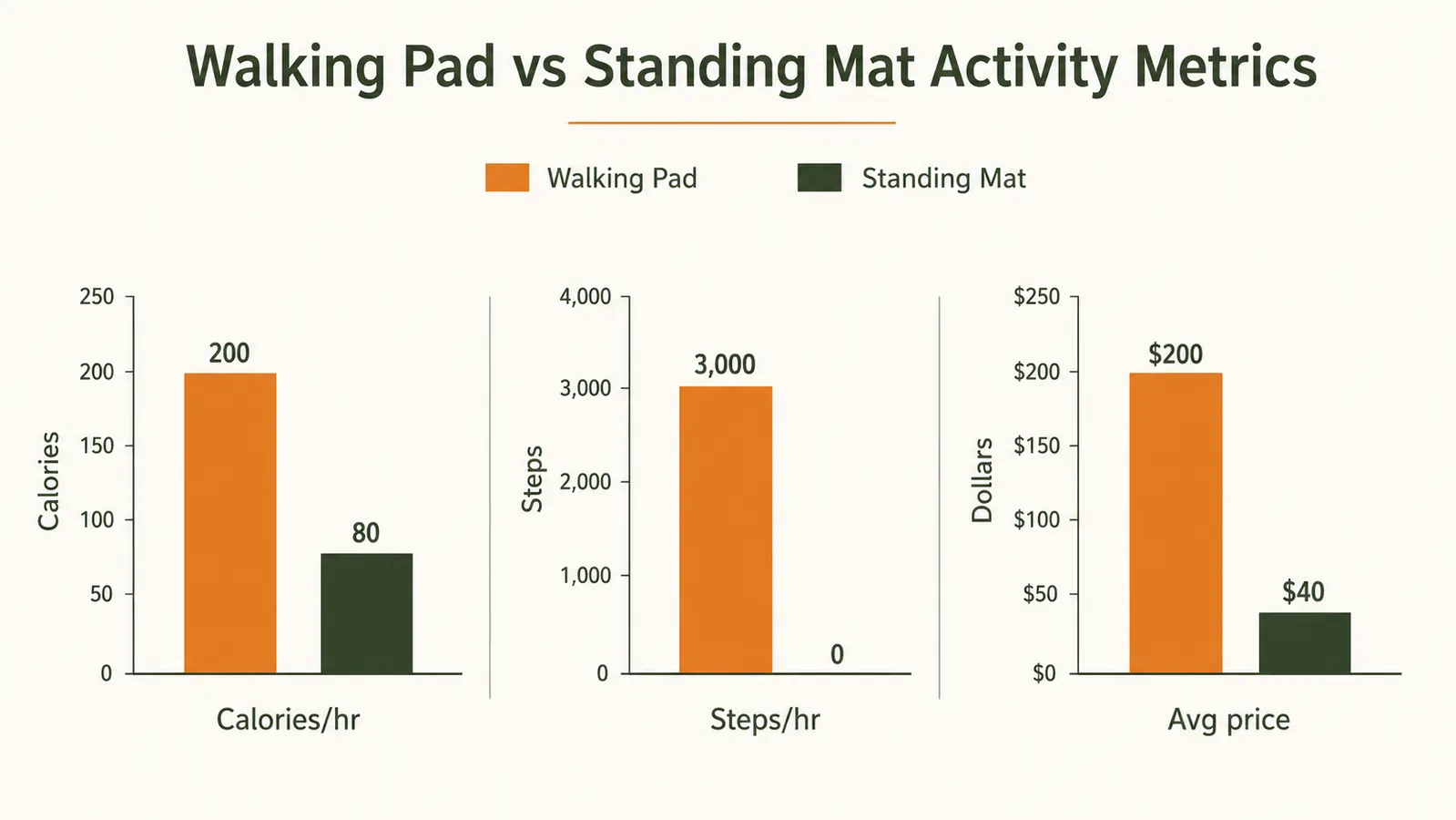
Where an Anti-Fatigue Mat Wins
Anti-fatigue mats are genuinely good at the thing they are designed to do. If you already have a standing desk and you stand for a few hours every day, a quality mat reduces foot and leg fatigue noticeably. The cushioning distributes pressure better than a hard floor, and some people find that subtle micro-movements encouraged by the mat's texture help a little with circulation. A good mat in the mid-price range requires no power, makes no noise, and works anywhere. It is also invisible to housemates or family members, which matters if your home office shares a wall with a bedroom.
The mat also wins on simplicity. There is nothing to set up, no remote control to find, no belt to eventually replace. You put it on the floor and stand on it. If you travel frequently and want something for a hotel room standing desk, a mat rolls up and fits in a bag. The walking pad stays home. For people who are primarily concerned with foot comfort during occasional standing sessions, a mat is the right-sized solution for the problem.
If movement is the goal, the mat is not enough. See today's price on the TRAILVIBER.
The TRAILVIBER walking pad has 9 auto-incline levels, a 450-lb capacity, and enough clearance to slide under most standing desks. It is the walking pad I recommend to anyone who is serious about moving more during the workday.
Amazon Check Today's Price on Amazon →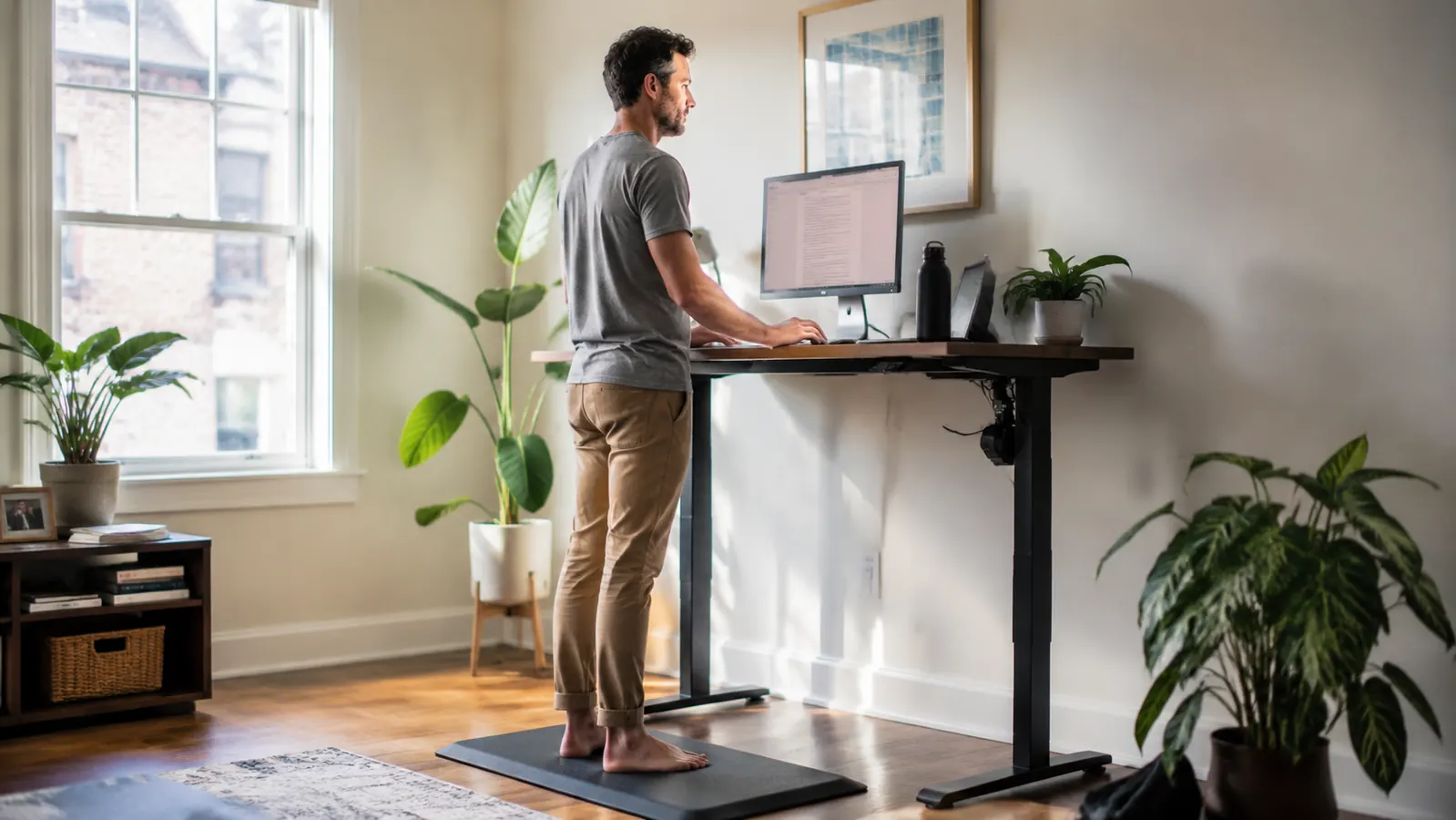
The Real Problem With Static Standing
Here is something most anti-fatigue mat reviews do not tell you: standing still is not that much better than sitting still. Research from the British Journal of Sports Medicine and several ergonomics studies has consistently found that the health risks associated with prolonged sedentary behavior come from physical inactivity, not just from being in a seated position. Static standing introduces its own problems: varicose veins, lower back compression, and leg swelling are all common complaints among people who stand in one place for hours. The anti-fatigue mat softens the impact on your joints but does nothing to create the blood flow and muscle engagement that comes from actual movement.
A walking pad sidesteps that entire problem. Even at 1 mph, you are generating muscle contractions throughout your lower body every step. Blood is moving. Your posture is dynamic rather than static. The afternoon energy crash that many remote workers experience is partly a blood sugar and circulation issue, and low-level walking addresses both. I noticed this difference within the first week of using the TRAILVIBER. By week three, I had stopped needing a second cup of coffee after lunch entirely. That was not a placebo. It was real. For a deeper look at the TRAILVIBER specifically, see the full TRAILVIBER review covering three months of daily use.
Who Should Buy Which
Buy the TRAILVIBER walking pad if you sit for most of the day and want to genuinely change that. If your goal is more movement, more energy, or burning some extra calories while you work, the walking pad is the only option between these two that actually delivers on those goals. It is also the right pick if you have back pain from sitting, feel foggy in the afternoons, or your doctor has told you to be less sedentary. The investment is real, but it replaces a gym membership for low-intensity cardio and removes the scheduling problem entirely. You do not have to carve out time to exercise. You exercise while you work.
Buy an anti-fatigue mat if you already stand regularly and your main complaint is foot or leg fatigue at the end of the day. A mat is also the right choice if noise is a hard constraint (sleeping baby next door, shared apartment wall, thin floors) or if your budget does not have room for a bigger purchase right now. There is nothing wrong with starting with a mat and upgrading to a walking pad later when the budget allows. The mat is not a bad product. It is just a much more limited one.
A few practical things to know before you order the TRAILVIBER: it requires a desk height of at least 40 inches to use comfortably while walking (most standing desks go that high, but check yours). The footprint is about 60 by 20 inches, which is narrower than you might expect. It stores vertically against a wall when not in use, which keeps it from dominating the room. And if you want to build walking into a full system for staying active while you work, the guide on how to stay active while working from home covers exactly how to do that without sacrificing productivity.
The TRAILVIBER is the walking pad I keep recommending. Here is why.
4.7 stars, 450-lb capacity, 9 auto-incline levels, and it fits under nearly every standing desk. If you are going to spend money on moving more during your workday, this is the version I would buy.
Amazon Check Today's Price on Amazon →